R129 conformity of production: batch testing explained
Passing type approval is the start. R129 Annex 12 sets how many production seats are crash-tested and what happens when a batch fails. Here are the numbers.
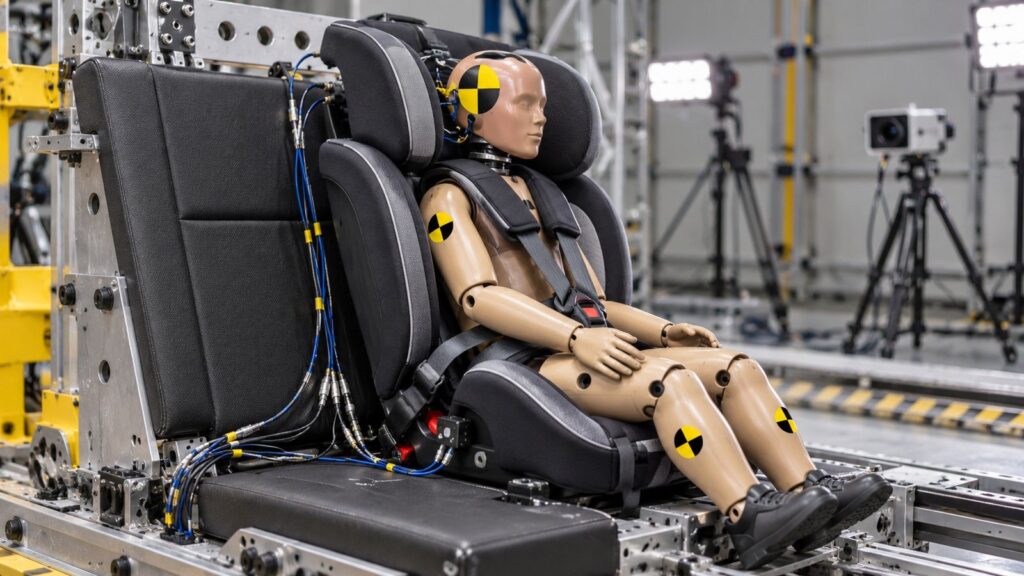
Short answer: R129 requires the approval holder to keep testing series production. For the Universal categories, seats are split into batches of no more than 5 000 that are sampled and dynamically tested, with stricter sampling after failures (Annex 12 §2.2.1). The authority normally verifies each production facility twice a year (§10.3).
1. Tests repeated at least once a year
Retractor locking and durability, strap strength after conditioning and abrasion, microslip, energy absorption and the temperature test are run on a statistically controlled, random basis, at least once per year (Annex 12 §1, §2.1).
2. Batch control for dynamic tests
Batches must be as uniform as possible in materials and production conditions — a different shell colour or harness manufacture counts as a difference (Annex 12 §2.2.1.1). Samples are taken from at least 20 % of the batch quantity (§2.2.1.2).
| Batch size | Control | 1st sample | 2nd sample |
|---|---|---|---|
| Under 500 | Normal | 1 seat, harder condition | 1 seat, harder condition |
| 500 – 5 000 | Normal | 1 harder + 1 less hard | 1 harder + 1 less hard |
| Under 500 | Strengthened | 2 harder | 2 harder |
| 500 – 5 000 | Strengthened | 2 harder + 2 less hard | 2 harder + 2 less hard |
“Harder condition” means the configuration with the least good results in approval or extension of approval (Annex 12, notes to Table 1).
3. How a batch passes or fails
- No defective unit in the first sample → batch accepted.
- Two defective units in the first sample → batch rejected.
- One defective unit → a second sample is tested and the cumulative count decides.
- A rejected batch is non-conforming and must not be released.
- Two rejected batches out of five consecutive ones → switch to strengthened control; five accepted in a row → back to normal.
- Two consecutive rejected batches under strengthened control → the provisions of §13 apply.
Results must not exceed the limit value L of each approval test (§2.2.1.6). Batch control starts with the batch after the one used for production qualification (§2.2.1.5).
4. Continuous control
Alongside batches, the holder runs continuous statistical sampling: 1 seat per 5 000 made under normal control, 1 per 2 000 under strengthened control. If a seat fails, a second is taken; if that one passes, production conforms (Annex 12 §2.2.2).
5. Who does the testing
In agreement with the authorities, tests can be carried out by the Technical Service or under the responsibility of the approval holder, who is responsible for traceability (Annex 12 §2.2.1.1, §2.2.2.1). The authority may verify the control methods at any time (§10.3), and an approval can be withdrawn if seats fail the checks or do not conform to the approved type (§12.1).
What buyers should ask a factory
- How are batches defined for my product, and what is the typical batch size?
- Which configuration is the “harder condition” for my seat?
- Where are CoP sled tests run — in-house or at the Technical Service?
- Can I see the latest CoP results and the dates of recent authority visits?
- What happens to my order if a batch is rejected?
More: type approval and conformity of production, R129 sourcing checklist.
We manufacture R129 seats and can walk you through how batches, sampling and sled tests are organised for your product.
Does every single seat get crash-tested?
No. Dynamic tests are destructive, so R129 uses sampling: per batch of up to 5 000, plus continuous sampling of 1 in 5 000 (normal) or 1 in 2 000 (strengthened).
Do these batch rules apply to specific vehicle seats?
Annex 12 §2.2 states the minimum conditions for the Universal categories. All approved seats remain under the general conformity of production requirements of §10; ask the Technical Service how they are applied to your product.
Guidance only. Check the authentic UN/ECE text and your Technical Service before relying on any requirement for approval.