ISOFIX or seat belt? R129 installation types compared
R129 allows several ways to fix a seat in a car. Which one is right depends on the car, the child’s size and how often the seat moves between vehicles.
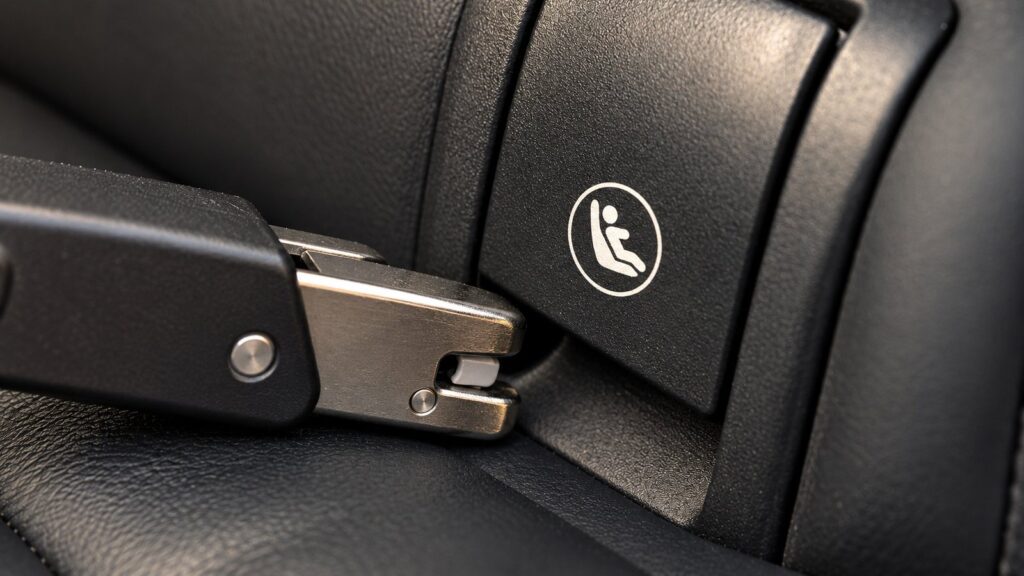
Short answer: R129 has three installation families — ISOFIX with an anti-rotation device (i-Size and specific vehicle ISOFIX), adult belt only (Universal Belted), and for boosters the adult belt with optional ISOFIX. None is “the safe one”: each passes dynamic testing for its category. The right choice is the one your car and child fit.
The options side by side
| Category | Seat held by | Child held by | Fits | Paragraph |
|---|---|---|---|---|
| i-Size (integral) | 2 ISOFIX attachments + top tether or support leg | Seat harness or shield | i-Size seating positions; others only if the manual or car fitting list allows | §6.1.2.1, §6.1.1 |
| Specific vehicle ISOFIX | ISOFIX attachments designed by the seat maker | Seat harness or shield | Vehicles on the seat’s vehicle list | §6.1.2.2 |
| Universal Belted | Adult safety belt only | Seat harness or shield | Universal seating positions | §6.1.2.3 |
| Specific vehicle Belted | Adult belt, possibly plus top tether, support leg or lower tethers | Seat harness or shield | Vehicles on the list | §6.1.2.4 |
| i-Size booster seat / Universal booster cushion | Adult belt; ISOFIX optional and must be stowable | Adult belt | i-Size positions (booster seat); i-Size and Universal positions (cushion) | §6.1.3.1, §6.1.1 |
When ISOFIX makes sense
- The car has i-Size or ISOFIX positions and the seat mostly stays in one car.
- You want a latching indicator: an ISOFIX seat must show clearly — by sound, feel or a visual signal — that both attachments are fully latched (§6.3.3.3).
- The child is in a harnessed seat. Note the cap: an ISOFIX integral seat plus the heaviest child it is approved for must not exceed 33 kg (§6.3.2.3), so harnessed ISOFIX seats stop at moderate sizes.
On an i-Size seat the top tether or support leg is not optional — it limits rotation of the seat in a crash (§2.12, §6.1.2.1). The manual must tell users that a support leg must touch the floor and straps must be tight (§14.3.7).
When a belted seat makes sense
- The car has no ISOFIX, or the position you need has none.
- The seat moves between several cars, such as grandparents’ cars.
- Belted integral seats must have a single adult-belt route with a main load-bearing contact point at least 150 mm from the Cr axis (§6.1.2.5), which keeps routing simple. Approved belt routes are marked in green (§4.6).
Boosters: ISOFIX is for stability, not restraint
On a booster seat or cushion the child is held by the adult belt. ISOFIX connectors, if fitted, are optional and must be stowable (§6.1.3.1). A booster with ISOFIX is still a belt-restraint product.
What to check before buying
- The category wording on the approval label — see how to read an R129 label.
- Your car handbook: which positions are i-Size, ISOFIX or Universal. An i-Size seat’s manual must refer you to the vehicle handbook (§14.3.17).
- For specific vehicle seats, the vehicle list — it must be visible at the point of sale (§14.2.5).
Technical detail: ISOFIX, top tether and support leg requirements.
Is ISOFIX safer than a seat belt installation?
Both pass the R129 dynamic tests for their category. ISOFIX reduces installation mistakes because the attachment is rigid and shows when it is latched; a belted seat depends on correct belt routing, so follow the green markings.
Can I use an i-Size seat in a car without i-Size seats?
Only if the seat’s instructions or car fitting list allow it. Forward-facing i-Size seats with a top tether may declare use in any ISOFIX position (§6.1.1).
Guidance only. Check the authentic UN/ECE text and your Technical Service before relying on any requirement for approval.